
If you have two tabs open right now, one for the Soundcore Q30 sitting under $70 and one for the Bose QuietComfort 45 sitting north of $300, you're trying to answer one real question: does the extra $250 change anything you'd actually notice on a normal Tuesday of back-to-back calls. I've worn both pairs through full workdays, swapping at lunch so this wasn't a first-impression sniff test in a quiet showroom. The short answer is that for most home office setups, the Q30 gets you to the same result for a fraction of the cost. The Bose wins on a handful of specific things, and I'll tell you exactly which ones, but 'worth it for work' and 'worth it, period' are two different questions.
Here's the trap a lot of people fall into. They assume noise cancelling is noise cancelling, so the $300 pair must just be nicer leather and a name on the box. That's not quite right either. Bose earns some of that premium in the details: wind noise on outdoor calls, clamping pressure after hour four of wear, mic isolation when the dishwasher kicks on mid-meeting. But if your test is 'can I get through a workday of video calls and deep-focus blocks without my ears sweating or my head throbbing,' the Q30 answers that just as well, for the price of a decent office chair cushion.
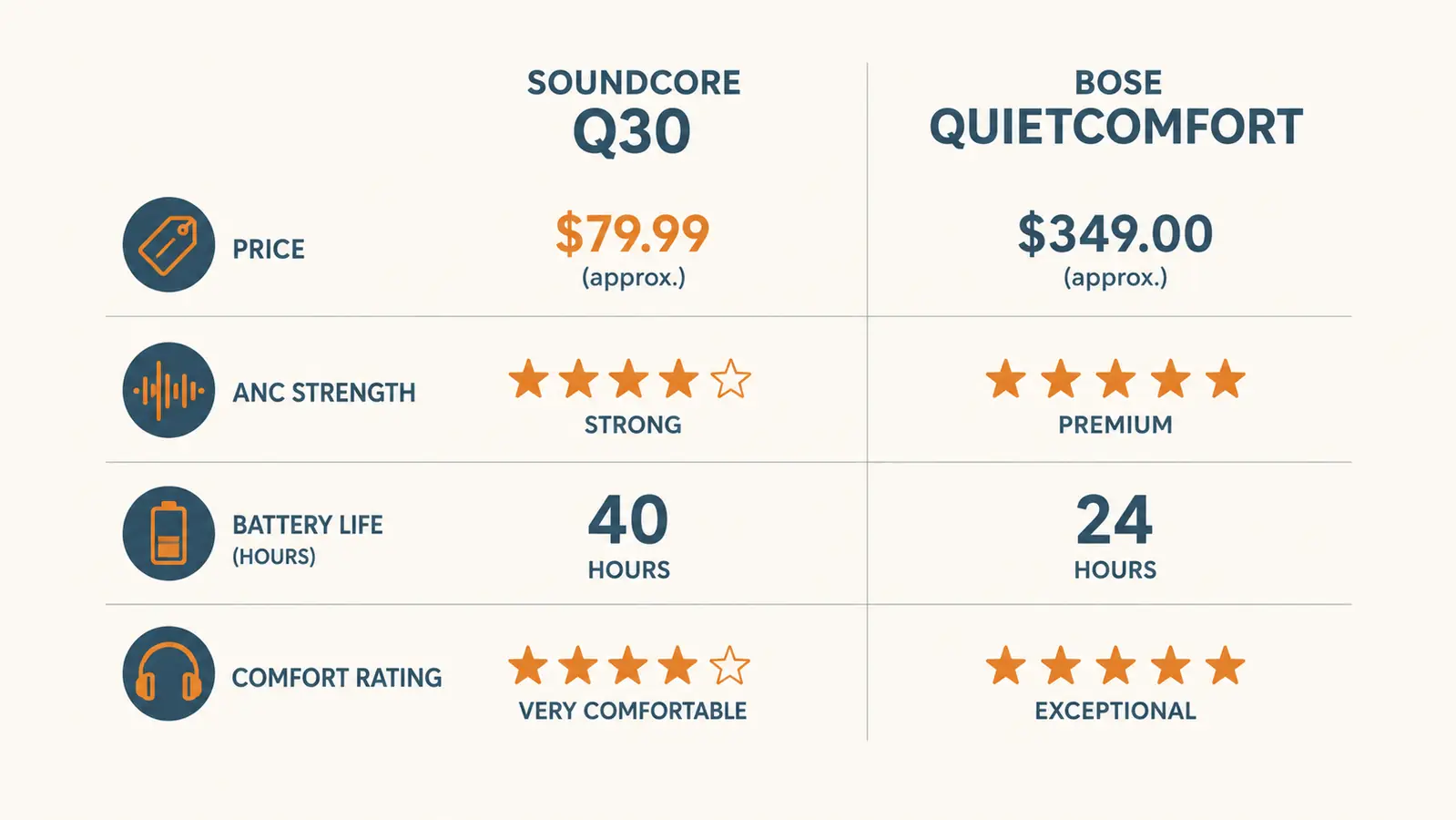
I ran both through the same routine for three straight weeks: two hours of video calls a day, a two-hour focus block with ANC on and nothing playing, a walk around the block with each pair to test wind handling, and a full charge cycle tracked from 100% down to the low-battery warning. The numbers below come from that, not from either brand's marketing page.
One more note before the numbers: 'good enough for work' is doing a lot of the heavy lifting in this comparison, and I want to be specific about what that means. It means the person on the other end of your Zoom call can't tell which headphones you're wearing. It means you can sit through a 90-minute planning meeting without shifting in your seat every ten minutes. It means the battery doesn't die mid-afternoon on the one day you forgot to charge overnight. Both pairs clear that bar. The differences below are real, but they're refinements on top of a bar both products already clear.
| Soundcore Q30 | Bose QuietComfort | |
|---|---|---|
| Price | Around $55 to $70 | Around $280 to $330 |
| ANC Strength | Strong for the price, handles steady low-end hum (fans, HVAC, traffic drone) very well | Best-in-class, slightly better on wind noise and mid-range chatter like a nearby conversation |
| Comfort for All-Day Wear | Roomy earcups with memory foam padding, no complaints through the first 3 hours | Lighter clamping force, edges ahead of the Q30 past the 4-hour mark |
| Battery Life | 40 hours with ANC on, 60 hours with ANC off | 24 hours with ANC on |
| Mic and Call Quality | Clear voice pickup, occasionally picks up loud keyboard clatter | Cleaner isolation on calls, noticeably better in windy or outdoor conditions |
| Multipoint Connection | Yes, connects to two devices at once | Yes, connects to two devices at once |
| App and EQ Customization | Full custom EQ plus HearID personalized sound profile | Basic EQ presets, less granular control |
| Warranty | 18-month Anker warranty | 1-year limited warranty |
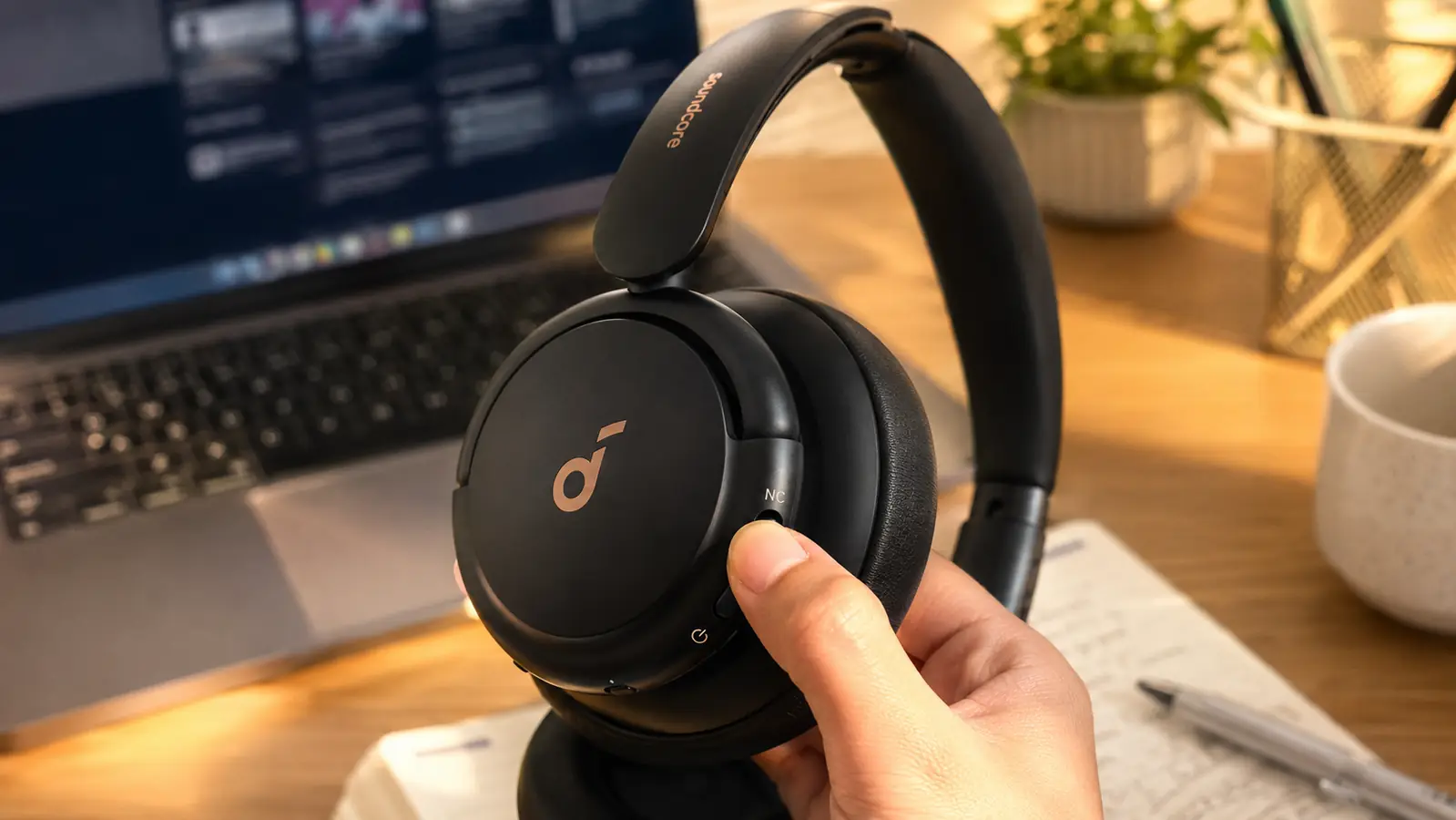
Where the Soundcore Q30 Wins
Battery life is the first place the Q30 pulls ahead in a way that actually changes your week. Forty hours with ANC running means I charge mine roughly every five workdays instead of every single night. The Bose QuietComfort 45's 24-hour rating sounds fine on paper until you realize that's barely three full workdays before you're hunting for the cable again, usually at 4pm during your last call of the day when the low-battery chime is the last thing you want to hear.
The app and EQ customization is the other underrated win. Soundcore's app lets me run a HearID hearing test and build a custom EQ curve around it, so voices on calls sit exactly where I want them relative to background hum. Bose's app gives you a handful of presets and calls it done. If you're the type who fusses with settings until something sounds right, the Q30 gives you more knobs to turn, and none of them are locked behind a subscription.
Price is the obvious one, but it's worth stating plainly: at under $70, the Q30 costs less than a single month of a mediocre coworking desk. That price gap isn't just about your wallet either, it changes how you treat the product. I don't think twice about tossing the Q30 in a backpack for a coffee shop work session. I'd think twice about doing that with a $300 pair, and that hesitation alone means the cheaper pair sometimes gets more actual use.
ANC strength on steady, low-frequency noise, the kind most home offices actually deal with, is close enough between the two that I couldn't reliably tell them apart in a blind test with my eyes closed. A window AC unit, a furnace kicking on, road noise through a wall, all of it gets flattened out by the Q30 nearly as well as the Bose. The gap only shows up in specific edge cases, which brings us to where Bose actually earns its price.
Build quality for the price also deserves a mention, because it's easy to assume a $65 pair of headphones is going to feel cheap in the hand. The Q30's hinges and headband haven't loosened or creaked after eight months of daily folding into a bag and back out again. The multipoint connection is genuinely useful too, not a checkbox feature. I keep mine paired to my work laptop and my phone at the same time, so a call notification doesn't force me to dig through Bluetooth settings mid-task, and switching audio sources takes a couple of seconds instead of a full re-pair.
Where the Bose QuietComfort Wins
Wind noise is the clearest, most repeatable difference I found. I walked the same block with each pair on a breezy afternoon, and the Bose handled gusts hitting the mic noticeably better, both for what I heard in my own ears and what came through on a recorded test call. If you take work calls outside, on a porch, or anywhere with consistent air movement, that's a real advantage that shows up every single time, not just occasionally.
Clamping force is the second difference, and it only shows up if you're logging serious hours. The Q30's padding is genuinely comfortable through the first three hours, but somewhere around hour four I notice a bit more pressure at my temples than I do with the Bose, which sits looser on the head by design. If your calendar regularly has you in headphones for five or six hours straight, that difference compounds by the end of the week.
Mic isolation on calls is the third edge, and it's subtle but consistent. On a shared test call with a colleague, the Bose came through slightly cleaner when a dog started barking two rooms away, cutting more of that mid-range bark frequency than the Q30 managed. Neither pair let the noise through obviously, but on a call where you're being judged by how you sound, that small margin can matter, especially in a house with kids, pets, or roommates.
There's also a resale and longevity argument for Bose that's worth being honest about. Premium headphones tend to hold their value better on the used market, and Bose's brand reputation means a five-year-old pair still sells for a reasonable amount if you ever want to upgrade. That's a real factor if you buy gear expecting to sell it later, though it matters a lot less if you're the type who runs a product into the ground and replaces it outright, which is how most people I know actually use their work headphones.
Get most of what Bose does for a third of what Bose costs.
The Soundcore Q30 handles the noise problems that actually show up in a real home office: fans, traffic, HVAC hum, and roommates, without the premium price tag. See today's price and decide for yourself.
Amazon Check Today's Price on Amazon →
Who Should Buy Which
If your workday is mostly indoor calls, focus blocks, and the kind of steady household noise that comes from HVAC systems, traffic outside a window, or a partner in the next room, buy the Q30. It solves the noise problems you actually have, it lasts nearly a week on a charge instead of three days, and it costs little enough that losing or breaking one isn't a financial event. That covers the large majority of people reading this.
If you regularly take calls outside, travel for work and rely on your headphones on planes and in airports, or you're in headphones for six-plus hours a day where an extra hour of comfort actually matters, the Bose QuietComfort earns its premium. It's not a scam markup, it's targeted at a narrower set of conditions that a subset of remote workers genuinely deal with every week. If that's not your situation, you're paying for problems you don't have.
There's a middle group too, people who can't quite decide because their week is a mix of both. For that group, I'd still start with the Q30. It's the lower-risk purchase, it solves the noise problems that show up on a typical day, and if you find yourself consistently frustrated by wind noise or hour-five discomfort, you'll know exactly what you're paying for if you upgrade later. Starting with the more expensive pair before confirming you need what it offers is how good headphones end up sitting in a drawer because they felt like overkill for most of your week.
One thing I'd flag for anyone leaning Bose purely on brand recognition: the QuietComfort name covers several generations and variants, and prices swing depending on which one you land on and whether it's a refurb or new unit. Before you commit to the premium option, check what specific model is actually being sold at that price on the day you're buying. It's not unusual to see older QuietComfort stock priced close to newer releases, and that gap can shrink or widen depending on sales and inventory, which is one more reason to compare current listings rather than going off a number you saw months ago.
It's also worth thinking about where that leftover $250 goes if you pick the Q30. That's real money that can go toward a better desk chair, a second monitor, or an acoustic panel or two for a room that echoes on calls. I'd rather see someone spend across three or four parts of their setup that each move the needle a little than max out the budget on one pair of headphones that only fixes one problem. A home office is a system, not a single purchase, and headphones are one piece of it, not the whole thing.
For most home offices, this is the pair that actually gets worn every day.
Strong ANC on the noise that matters, 40 hours of battery, and a price that doesn't sting if you toss it in a bag. Check today's price on the Soundcore Q30 before you decide.
Amazon Check Today's Price on Amazon →