

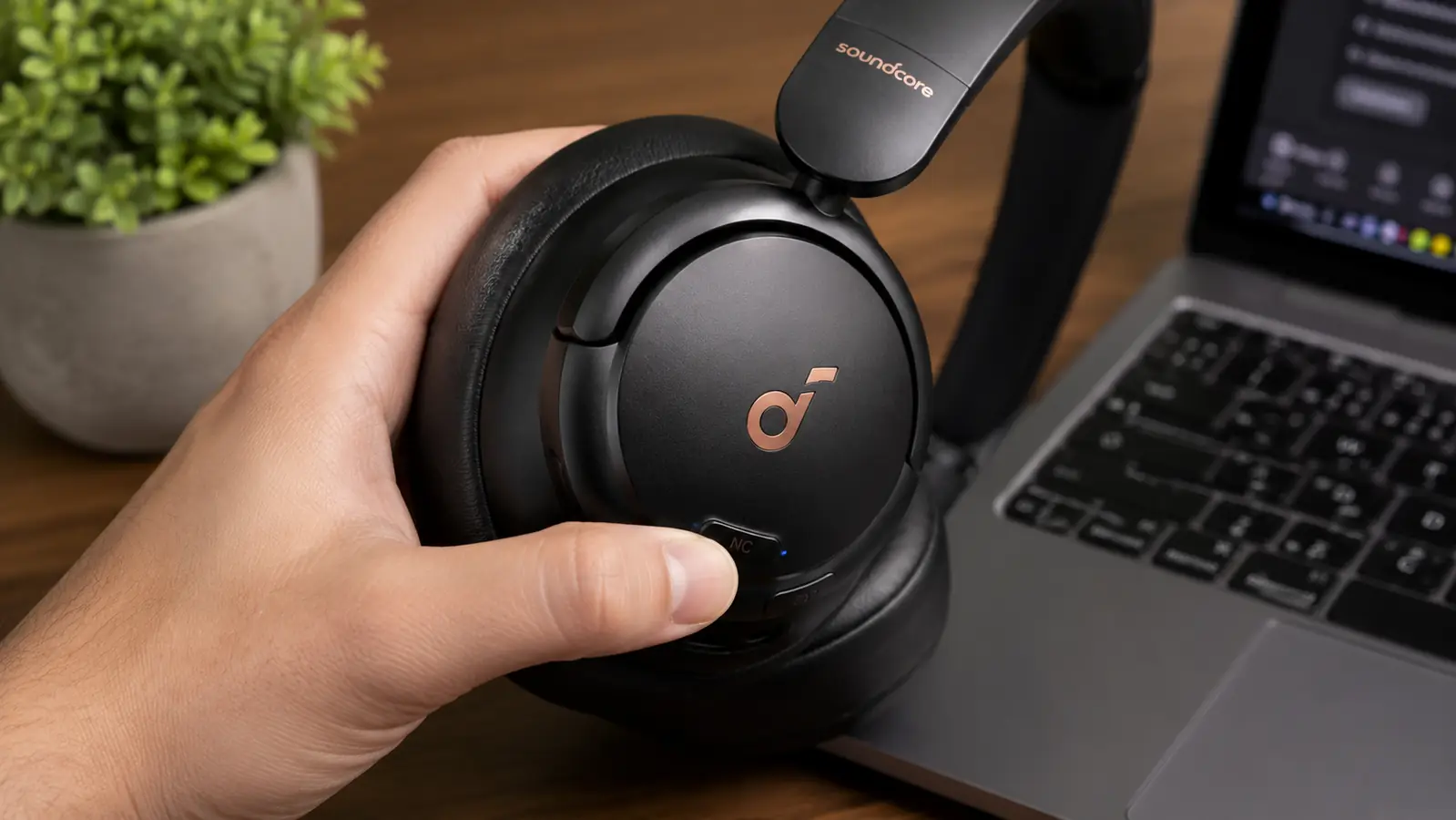
The dog starts barking the exact second you unmute. A kid slams a door down the hall right as you're mid-sentence in the client call. Your roommate picks 10am, every single day, as the ideal time to run the vacuum. If any of that sounds familiar, you already know the problem isn't your work ethic. It's that your house was never built to double as a recording studio, and nobody warned you it would need to. The single change that did the most for me was a pair of Soundcore Q30 headphones, and below I'll show you exactly where they fit into the fix.
You don't need to move to a soundproof cabin or gut a closet into a booth. Most household noise problems get solved by fixing three things in the right order: where the sound gets in, what's sitting between you and the source, and what's actually covering your ears. Get those three right and the barking, the door slams, and the vacuum stop being a threat to your calls.
This matters more than it sounds like it should. A dog going off in the background of a client call reads as unprofessional even when it's completely out of your control, and it's the kind of thing that quietly costs remote workers credibility over time. The good news is that the fix isn't complicated or expensive. It's five specific steps, done in the right order, and most of them take under an hour to put in place.
Start with what's actually on your ears, not another app setting
The Soundcore Q30 hybrid ANC headphones handle the low, constant stuff (vacuums, traffic, HVAC) automatically, and let you dial in transparency or full block-out mode for the sharp stuff like barking or a slammed door. 50 hours of battery means you're not chasing a charger mid-shift.
Amazon Check Today's Price on Amazon →Step 1: Find Where the Noise Is Actually Getting In
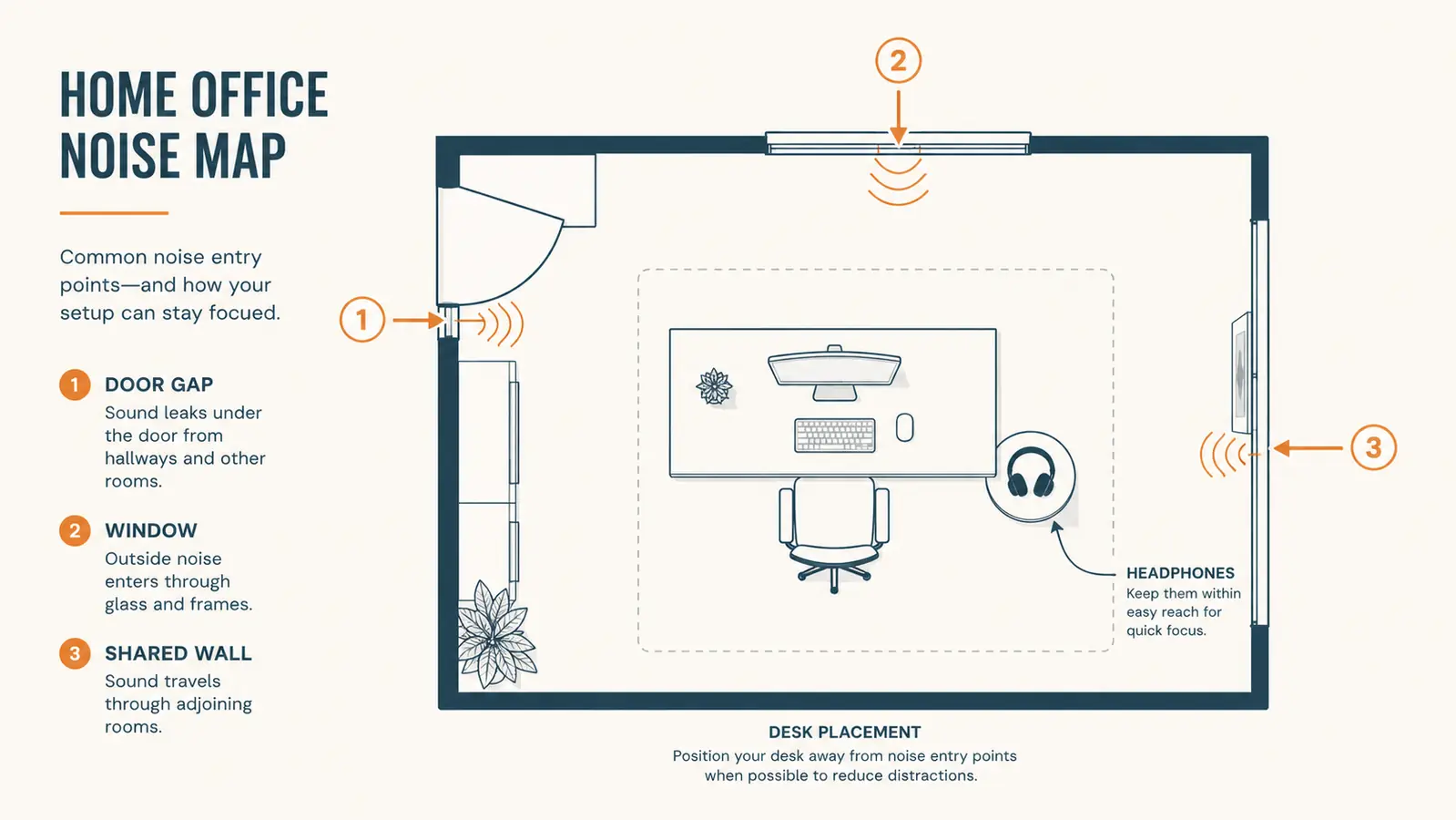
Before you buy anything, spend one call cycle just listening. Most home offices have two or three specific entry points, not a general noise problem. It's usually a door with a half-inch gap at the bottom, a window facing the street, or a shared wall with a laundry room or kids' playroom on the other side.
Walk your space with your phone recording a voice memo for 60 seconds. Play it back. You'll hear exactly which direction the worst of it is coming from. That tells you whether you need a door sweep, a heavier curtain, or just to angle your desk so your back, not your face, is closest to the noisy wall.
Don't overlook the entry points people forget: HVAC vents that carry sound straight from the living room, a hollow closet door repurposed as an office wall, or a window AC unit that rattles every time it cycles. These are usually easy fixes once you know they're the culprit, but almost impossible to diagnose by guessing.
This step costs nothing and most people skip it, which is why they end up buying the wrong fix. A $60 pair of headphones can't out-cancel a door that's basically open. Seal the obvious gap first, then layer everything else on top of it.
Step 2: Put a Physical Barrier Between You and the Source
Once you know where the noise comes from, put something solid in its path. A closed, weather-stripped door blocks more sound than people expect, and a $10 door sweep from the hardware store closes the gap that a hollow-core door leaves at the bottom. If your desk backs up to a shared wall, even sliding it a few feet away or turning the back of a bookshelf toward that wall makes a measurable difference.
Furniture does more work here than most people give it credit for. A fully loaded bookcase against a shared wall absorbs and breaks up sound that would otherwise pass straight through drywall. Even a couple of thick blankets hung over a closet door, out of frame from your camera, can knock down the sharpest edges of a noise before it reaches you.
Weatherstripping tape and acoustic caulk around a door frame cost less than a coffee run and take fifteen minutes to apply. They close the tiny gaps that let high-pitched sound (a kid's voice, a dog's bark) leak straight through even when the door looks fully closed. It's one of the cheapest fixes on this list and one of the most overlooked.
If a full renovation isn't in the cards (it usually isn't), think in layers instead of one big fix. A rug on a hard floor, a heavier curtain over a thin window, and a closed door together do more than any single expensive purchase. The goal here isn't silence. It's cutting the volume down before it ever reaches your ears, so the next step doesn't have to work as hard.
Step 3: Get Real ANC Headphones, Not Just Earbuds
This is where most people are underequipped without realizing it. Basic wired earbuds or a cheap Bluetooth set might block a little sound with the seal in your ear canal, but they do nothing for the low rumble of a vacuum, a dishwasher, or a dog's bark carrying through drywall. Active noise cancelling headphones use microphones to sense that ambient sound and cancel it out electronically, on top of the physical seal.
The Soundcore Q30 is built specifically for this kind of daily desk use. Hybrid ANC (mics inside and outside each ear cup) handles both the low constant stuff and higher-pitched noise better than single-mic ANC does. You get multiple ANC modes so you can dial it toward outdoor, indoor, or transit noise depending on what your house is throwing at you that day, plus a transparency mode for when someone needs to grab your attention without you ripping the headphones off.
Over-ear also beats earbuds for anything longer than a quick check-in call. The bigger ear cups create a full physical seal around your ear rather than just plugging the canal, which handles low-frequency noise better and doesn't leave your ears sore after back-to-back meetings the way small, hard earbud tips can.
50 hours of playback per charge means you're not stopping mid-afternoon to plug in, and the ear cushions are soft enough to wear through a full back-to-back meeting day without your ears aching by 3pm. At a price well under the premium noise-cancelling brands, it's a low-risk way to test whether ANC actually solves your specific noise problem before spending three times as much on a flagship pair.
Step 4: Set Your Mic and Call App Correctly
Blocking noise on your end only solves half the problem. If your microphone is picking up the barking and sending it to everyone on the call, your headphones don't help the person on the other end at all. Open your video call app's audio settings (Zoom, Teams, and Meet all have this) and turn on background noise suppression, usually listed as "High" or "Auto." This filters out consistent background sound on the outgoing audio, separate from what's cancelled on the incoming side.
Use the headset's built-in microphone instead of your laptop's internal mic whenever possible. A mic positioned closer to your mouth naturally picks up less of the room around you, which means the software has less noise to fight in the first place. Combine a decent headset mic with noise suppression turned on, and a sudden bark or door slam usually gets cut down to almost nothing on the other end, even if you still hear a bit of it yourself.
It's worth testing this once instead of assuming it works. Join a solo test meeting, have someone in your house make a normal amount of noise, and record it. Play the recording back and you'll know exactly how much is getting through on the outgoing side, which is usually a very different picture than what you hear on your own end.
If you're still hearing yourself echo or picking up room noise after all that, check whether your call app is set to use your laptop's speakers as the audio output instead of the headphones. It sounds obvious, but a mismatched input/output setting is one of the most common reasons ANC headphones seem to "not work" for calls when the hardware is actually fine.
Step 5: Build a Household Signal for "I'm On a Call"
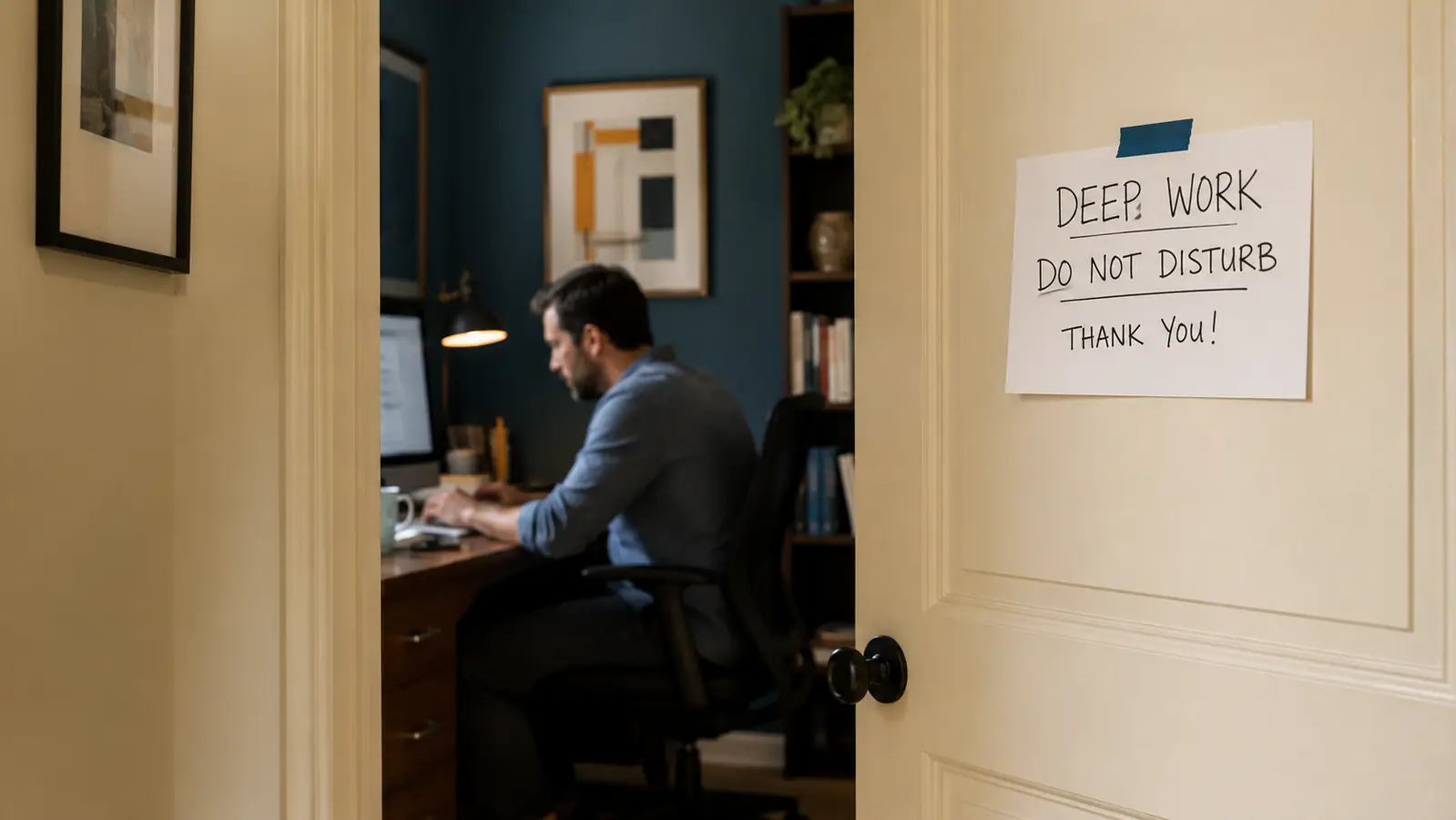
Gear solves the noise you can't control. It doesn't solve the noise you could control if the rest of your household knew you were live. A simple sign taped to the outside of your door, a lamp turned on as a visual cue, or just a group text at the start of your shift ("on calls until 3, please keep it down near the office") heads off a lot of the avoidable stuff before it starts.
If you've got kids or roommates, agree on one clear signal everyone respects rather than hoping people remember your schedule. Something as basic as a closed door meaning "do not knock unless it's urgent" removes the guesswork and cuts down on the mid-call interruptions that no amount of ANC can fully undo.
It also pays to know your household's predictable noise windows and schedule around them when you have a choice. If the dishwasher always runs at 9am or the dog walker shows up at noon, block those slots out on your calendar as "no external calls" time when you can, and save the flexible windows for internal meetings where a little background noise is more forgivable.
Headphones fix the noise you can't control. A closed door and a five-second heads-up text fix the noise you could have.
What Else Helps
If your space is loud enough that headphones alone aren't cutting it, a few cheap add-ons compound the effect. Soft surfaces (rugs, curtains, even a fabric wall hanging) reduce echo and reflected sound, which matters if your office has hard floors and bare walls. A white noise source running quietly in a hallway or shared space can mask sudden spikes like a dog bark before they ever reach full volume. And if you're on video as well as audio, closing blinds or facing away from a street-side window cuts down on distracting movement that pulls your own focus mid-call, separate from the audio problem entirely.
Tackle these in order of cost and effort, not the other way around. Sealing a door gap and rearranging furniture is free or close to it. A solid pair of ANC headphones is the next step up and does the most work per dollar spent. Anything beyond that, dedicated acoustic panels, a white noise machine, a room divider, is worth adding only if the first two steps still leave gaps once you've actually tested them on a real call.
Fix the part you actually control today
You can't control when the dog barks or when someone starts the dishwasher. You can control what's on your ears when it happens. The Soundcore Q30 gives you hybrid ANC, a transparency mode for when you need it, and 50 hours of battery so it's ready for every shift, not just the important ones.
Amazon Check Today's Price on Amazon →