

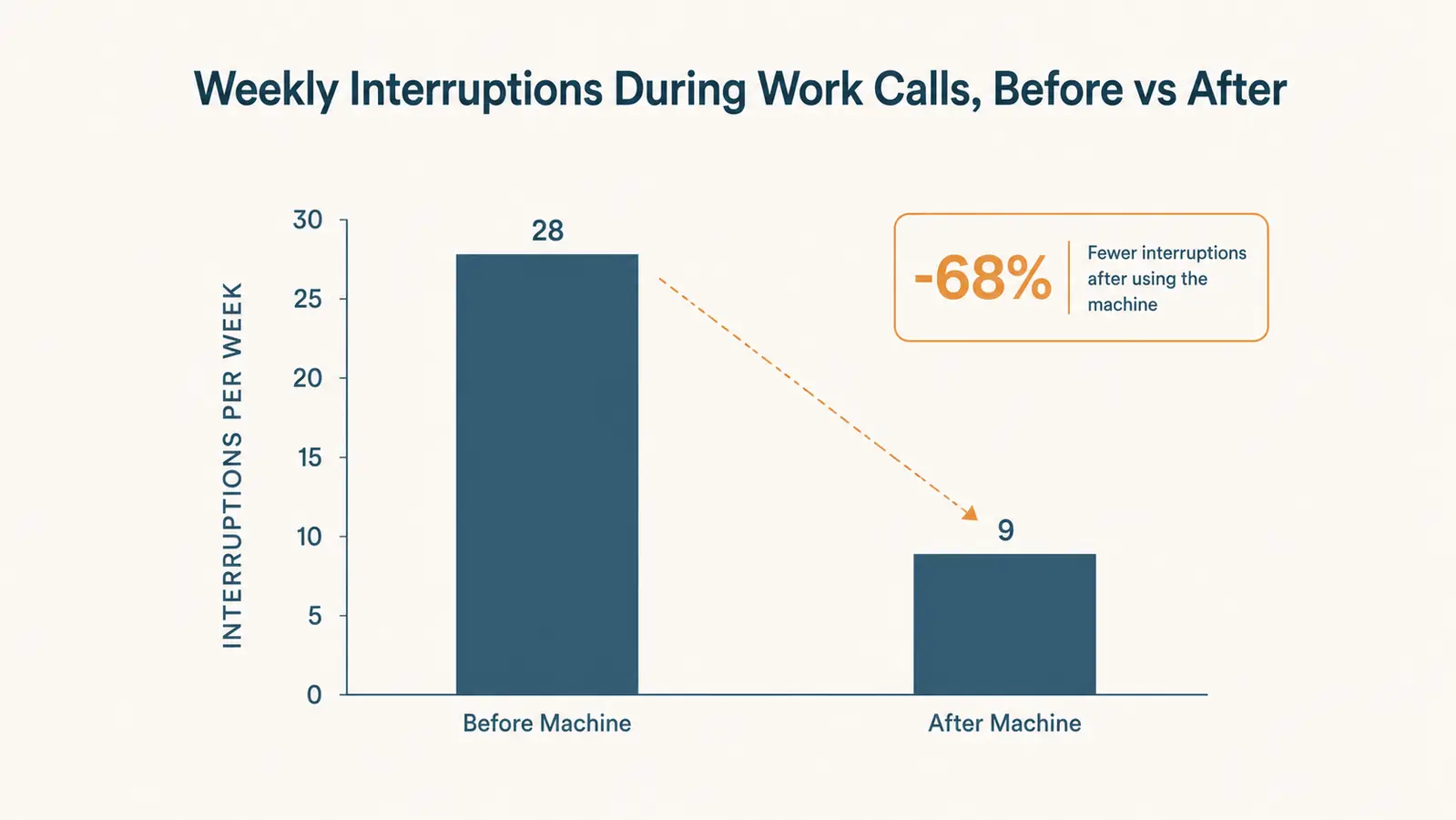
My home office is a converted dining nook eight feet from the kitchen, which felt like a smart use of space until I actually started working from it. My two teenagers treat the microwave like a hobby, our dog Bosco loses his mind every time the mail truck idles at the curb, and my wife works twelve-hour night shifts as an ICU nurse, which means she's often asleep upstairs at 2pm while I'm on a claims call downstairs trying not to wake her with a laugh that carries. Seven months ago, after a client heard Bosco bark through an entire settlement explanation, I bought a $17.76 Magicteam white noise machine off Amazon mostly out of embarrassment. I still run it five days a week, every week, which is the only review score that actually matters to me.
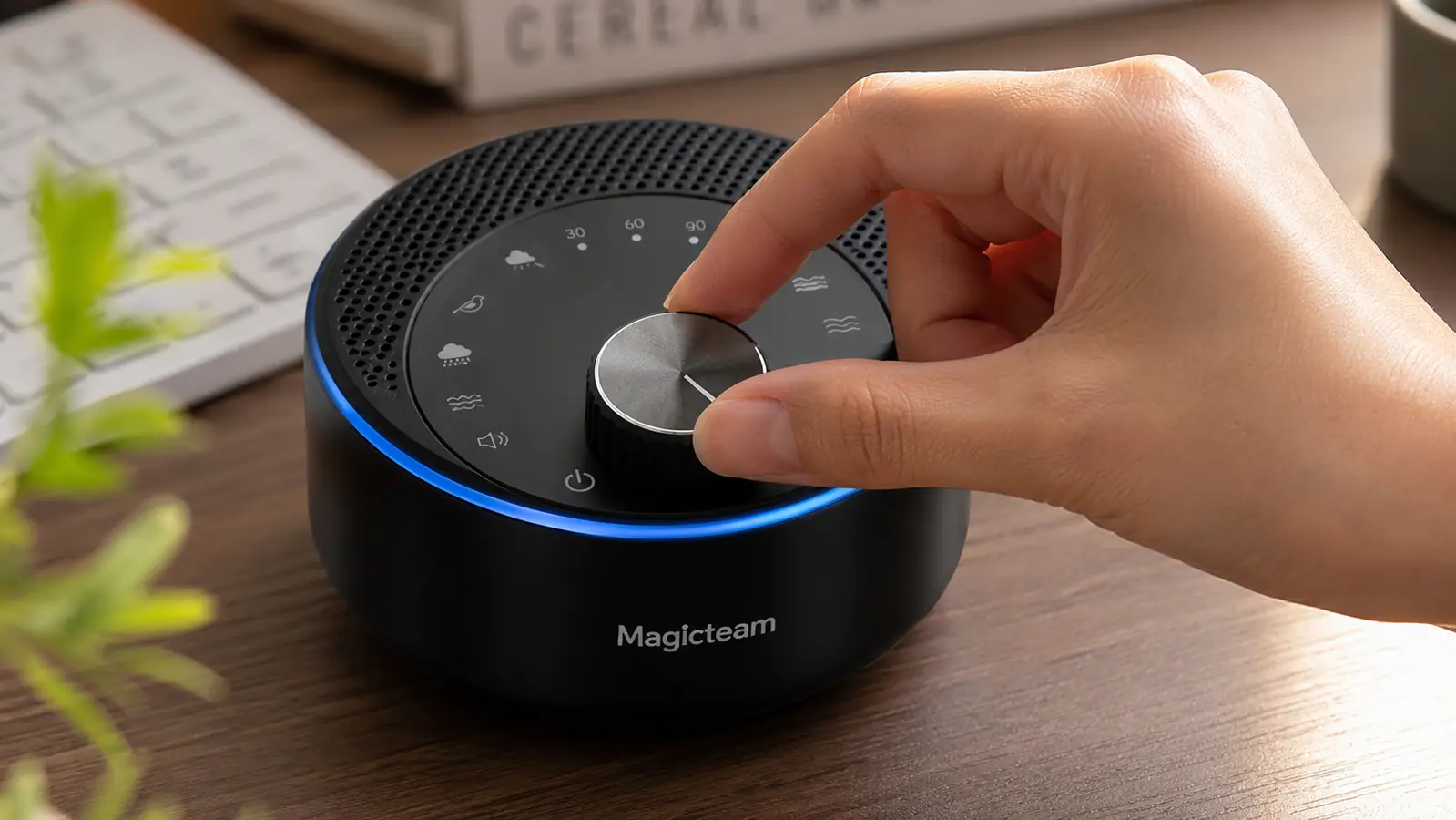
The Magicteam Sound White Noise Machine is not a complicated device. It's a plastic disc about the size of a hockey puck with 20 built-in sounds, a dial that steps through 32 volume levels, a sleep timer you can set from 30 minutes up to all night, and a memory function that saves whatever sound and volume you last used so you're not re-dialing it every morning. It runs on AC power through the included adapter or off a USB cord, which turned out to matter more than I expected once I started moving it between my desk and my nightstand. I keep mine plugged into the wall behind my monitor, running for six to eight hours most workdays.
The Quick Verdict
A cheap, no-frills sound masker that has run daily for seven months without a hiccup. It won't fix an echoey room, but for masking household noise during focused work, it earns its spot on the desk.
Amazon Check Today's Price →Still Getting Caught Mid-Call By Something You Can't Control?
Barking dogs, microwaves, a spouse sleeping off a night shift, none of that stops just because you're on a client call. The Magicteam machine masks it before it reaches the mic, and it costs less than a fast food combo meal.
Amazon Check Today's Price on Amazon →How I've Used It
I didn't buy this to fix an audio problem on my end of a call. My mic and headset were fine. The issue was everything happening around me that a decent microphone actually does pick up if it's loud enough, kids' footsteps overhead, Bosco's bark, the dishwasher running through its cycle two rooms away. I set the machine on the back corner of my desk, angled slightly toward the doorway into the kitchen, since that's the direction most of the noise comes from. It sits between my monitor stand and a small plant, close enough that I can reach the dial without leaning.
For most of the workday I run it on the white noise setting at around level 14 out of 32, low enough that it doesn't show up on my calls but high enough that it smooths over the sharper spikes of a slammed door or a dog bark before they fully register. On days when the house is louder than usual, kids home sick, contractors working next door, I'll bump it up to 18 or 20. I've tried a handful of the other 19 sounds, rain and ocean waves mostly, but white noise is what I default to for work since it doesn't pull my attention the way a more textured sound like rain does.
The memory function turned out to be a bigger deal than I gave it credit for when I first read the box. I unplug it and move it to my nightstand most nights so my wife can use it before her overnight shifts, then bring it back to the desk in the morning. Without the memory function I'd be re-dialing the sound and volume every single time. Instead it just picks back up wherever I left it, which is a small thing but it's the difference between actually using a device daily and letting it collect dust after week two.
The Sound Library: Why Non-Looping Actually Matters
Magicteam advertises the 20 sounds as non-looping, and I was skeptical of that claim before I actually sat with it for a full workday. Cheaper white noise apps and machines I've tried before this one have an obvious loop point, a two or three second clip that repeats over and over, and once your brain locks onto that repetition it becomes its own distraction. I timed a few of the tracks on my phone against a stopwatch out of curiosity, and the white noise, rain, and ocean settings all ran well past a minute without an audible seam where the sound restarted. I never once caught myself noticing a loop during a work session, which was the actual test that mattered.
The 20 sounds break down roughly into three categories, mechanical whites and pinks (white noise, pink noise, a fan sound), nature sounds (rain, ocean, stream, thunder, campfire, birds), and a handful of rhythmic ones like a heartbeat and a train, which I assume are aimed more at the baby-sleep crowd than remote workers. For daytime focus work, I use white noise almost exclusively. For my wife's daytime sleep before a night shift, she prefers the rain setting, and she's told me more than once that it's the one thing that's actually helped her sleep through our neighborhood's daytime lawn crew.
Sound quality is honest for the price. It's a single small speaker, so there's no bass depth to speak of, and at the top few volume levels I can hear a very slight edge of distortion on the ocean wave setting specifically. White noise itself, being closer to a flat static than a layered sound, holds up fine even cranked to the higher levels. If you're expecting studio-grade audio out of an $18 device, you'll be disappointed. If you're expecting effective masking, it delivers.
The Volume Range and Sleep Timer in Practice
Thirty-two volume levels sounds like overkill for a $17.76 machine, but the range actually earns its place once you're using the same unit for two very different jobs. At my desk during the day, I sit somewhere between level 12 and 20 depending on how loud the house is. On my wife's nightstand at night, she rarely goes above level 5 or 6, since a bedroom at 2am needs a fraction of the coverage a busy household needs at 2pm. Having that much granularity between barely-there and full coverage means one machine actually covers both use cases instead of us needing a second device.
The sleep timer gets used almost exclusively by my wife rather than me. She sets it for four to six hours before an overnight shift so the machine shuts off on its own instead of running all day while she's out of the house. I've tested the timer accuracy a few times against my phone's clock and it's never been off by more than a minute or two, which is close enough for what it's doing. During my workday I just leave the machine running continuously and shut it off manually at the end of the day, so the timer is a feature I appreciate more in theory for her routine than I actually rely on for mine.
One small gripe worth mentioning: the dial has no numbered markings printed on it, just a plain notch you can feel click into place, so dialing back into my usual level 14 after cleaning or moving the unit takes a bit of trial and error rather than lining up to a printed number. It's a minor thing once you've used the machine for a few weeks and your ear learns where your preferred setting sits, but if you like precise, repeatable settings without guesswork, it's worth knowing going in.
Seven Months In: What's Held Up and What Hasn't
The unit has run essentially every workday since early December, plus most nights on my wife's nightstand. That's a lot of plug-in, unplug, move, plug-in cycling for a $17.76 device, and I expected the power connector or the dial to be the first thing to fail. Neither has. The volume dial still has a firm, consistent click through its range with no looseness, and the AC adapter connection hasn't gone intermittent the way cheap electronics sometimes do after months of being unplugged and replugged.
The one component that's shown real wear is the USB cord we occasionally use instead of the AC adapter when the machine travels with my wife on a work trip. The connector end has started to feel slightly loose, requiring a small wiggle to get a solid charge indicator. The wall-plug AC adapter, which is what I use 95 percent of the time at my desk, has had zero issues. If you plan to run this primarily off USB rather than AC, I'd keep that in mind, though for a fixed desk setup like mine it's a non-issue.
Dust has settled into the speaker grille the way it does on anything sitting on a desk for months, and I've run a soft brush over it twice since December. The plastic housing hasn't yellowed or cracked despite sitting partly in direct window light for a chunk of the afternoon. For a device in this price bracket, seven months of daily use without a functional failure is more than I expected going in.
What I Tried Before This
Before spending the $17.76, I tried two free alternatives that a lot of remote work forums recommend first. A white noise app on my phone worked fine in theory, but my phone kept getting pulled into actual calls or notifications, which meant the sound would cut out mid-session exactly when I needed it most. A browser tab playing a ten-hour white noise video from a streaming site worked a little better, until my browser crashed twice in one month and took the noise with it along with whatever tabs I actually needed for work.
I also looked at acoustic foam panels for the wall behind me, since a coworker on my team swears by them for her home office. Panels solve a different problem than mine, though. They cut down on echo bouncing around inside a hard-surfaced room, which wasn't my issue since my dining nook has carpet and curtains already. My problem was noise coming from other rooms into mine, which foam panels do very little about. A dedicated masking device that doesn't depend on my phone or laptop staying open turned out to be the more direct fix for what I was actually dealing with.
What I Liked
- 20 genuinely non-looping sounds, confirmed with a stopwatch over multiple work sessions
- Memory function saves your last sound and volume, useful if the unit gets moved between rooms
- 32 volume levels gives fine control between barely-there masking and full coverage
- Runs on AC or USB, flexible for a desk setup or travel
- Held up through seven months of daily plug-in-unplug use with no functional failures
Where It Falls Short
- Single small speaker means no real bass, and slight distortion at the highest few volume levels on some sounds
- USB connector has started to feel slightly loose after months of repeated use
- Doesn't address echo or reflected sound inside your own room, only noise entering from elsewhere
- No printed markings on the volume dial, so returning to your preferred level takes a bit of feel
- No app or phone control, everything is manual on the unit itself
It didn't make my house quiet. It made the noise stop mattering by the time it reached the call, and that's really all I was asking of an $18 plastic disc.
Who This Is For
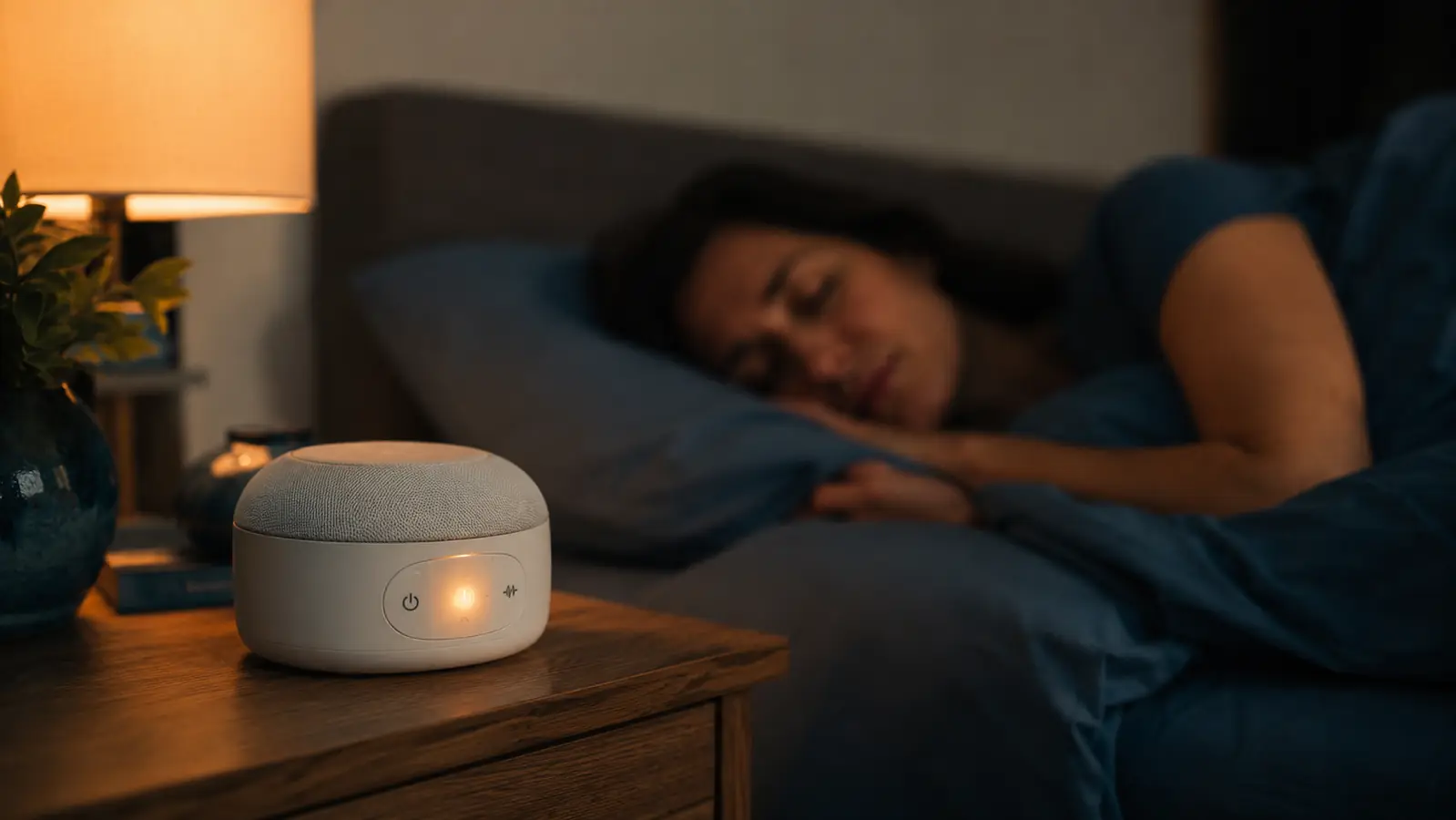
If you work from a house with other people in it, kids, roommates, a partner on a different schedule, a dog with opinions about the mail truck, this is a cheap and low-risk way to keep that noise from bleeding into your calls and focus time. It's also worth a look if someone in your house needs to sleep during hours the rest of the household is active, since the same unit that gets me through a workday is what my wife runs to sleep through a loud afternoon before a night shift. Anyone renting an apartment with thin walls and noisy neighbors will get similar value out of it.
Who Should Skip It
If your actual problem is an echoey room with bare walls making your own voice sound hollow on calls, this won't fix that, since it masks incoming noise rather than absorbing reflected sound, and you'd be better served by acoustic panels instead. It's also not the right buy if you need serious bass or a rich, layered soundscape, since the single small speaker is built for function over fidelity. And if your house is genuinely quiet already, you're solving a problem you don't have.
Your Next Call Doesn't Have to Compete With Your Whole House
Seven months later, this is still the cheapest fix on my desk and the one that's quietly saved me from at least a dozen awkward mid-call interruptions. If your house is as loud as mine, it's a low-risk way to find out fast.
Amazon Check Today's Price on Amazon →