

Quick answer, since that's probably why you searched this. If the problem is noise coming from outside your room, a dog barking, a delivery truck, a roommate's TV through the wall, the Magicteam White Noise Machine solves that better than foam ever will. If the problem is your own voice bouncing around a bare-walled room and coming back sounding hollow on calls, acoustic panels are the better first purchase. These two show up in the exact same search results because they both get filed under "quieter home office," but they're built to fix two different complaints, and buying the wrong one is the single most common mistake I see people make when they're trying to clean up their work-from-home audio.
I run my home office out of a converted attic bedroom with a sloped ceiling, a thin interior door, and a floor register that pipes in every sound from the kitchen below. Before I bought either product, my afternoon calls were a mess. My wife's blender, the dog losing his mind at the mail truck, my neighbor's landscaping crew twice a month, all of it came through loud and clear on my end and, worse, on the other end of the call too. I tested the Magicteam machine for three weeks running it near the door at a medium setting, then set it aside and mounted a dozen acoustic foam panels on the wall behind my desk for another three weeks to see which one actually moved the needle on my recorded test calls.
It's worth being honest about why this comparison trips people up in the first place. Both products get marketed as fixes for a distracting home office, both cost under $20, and both show up in the same roundup articles, so it's an easy assumption that they're interchangeable. They're not, and I made that exact mistake myself the first time around, buying the white noise machine expecting it to also clean up how I sounded on calls. It masked the outside noise beautifully and did absolutely nothing for the fact that my own voice still sounded like it was coming from inside a stairwell. Knowing which of those two problems you actually have before you spend money saves you from buying a second product a few weeks later when the first one doesn't do what you assumed it would.
| White Noise Machine | Acoustic Panels | |
|---|---|---|
| Price | $17.76, one-time purchase | Roughly $14 for a 12-pack, one-time purchase |
| What It Actually Does | Generates a steady background sound that covers up noise coming from outside the room | Absorbs sound reflections off hard walls, cutting down echo and reverb inside the room |
| Blocks Noise From Elsewhere in the House | Yes, this is its entire job and it does it well | Minimal, foam absorbs reflections but doesn't stop sound traveling through walls or doors |
| Fixes Hollow or Echoey Voice on Calls | No, and running it in an already reflective room can add a second layer of noise rather than fix the first | Yes, directly, since echo comes from your own voice bouncing off bare surfaces |
| Setup Time | Plug in or run on batteries, ready in under a minute | Command strips or included adhesive, about 30 to 45 minutes for a full wall |
| Portability | Fully portable, move it desk to desk or pack it for a hotel room | Semi-permanent once mounted, leaves light adhesive marks if you take it down |
| Works Without Being Turned On | No, only masks noise while it's actively running | Yes, works passively at all times, no power needed |
| Best For | Rooms where the echo is fine but noise keeps bleeding in from outside the room | Rooms with hard, bare walls and a noticeable hollow or bathroom-like sound on calls |
How I Actually Tested Both
I didn't want to just eyeball this, so I recorded the same 60-second voice memo in my attic office three separate times: once untreated, once with the Magicteam machine running near the door instead of any wall treatment, and once with the panels mounted and the machine switched off entirely. I picked a fixed spot to stand and a fixed volume for the background chaos downstairs, running the dishwasher and letting the dog outside during each recording so the outside-noise variable stayed consistent across all three tests. That gave me a real before-and-after for each product instead of a gut feeling based on one good call and one bad one.
The results lined up almost exactly with what the physics predicts, which is honestly a little satisfying to confirm firsthand rather than take on faith from a product description. The untreated recording had both problems at once, an echoey slap-back on my own voice and the dishwasher clearly audible in the background. The panels-only recording killed the echo but the dishwasher was still there, just as loud as before. The white noise machine recording buried the dishwasher completely under the ocean-wave setting, but my voice still had that same hollow quality underneath it. Neither one is a universal fix, and anyone telling you otherwise hasn't actually run the test.
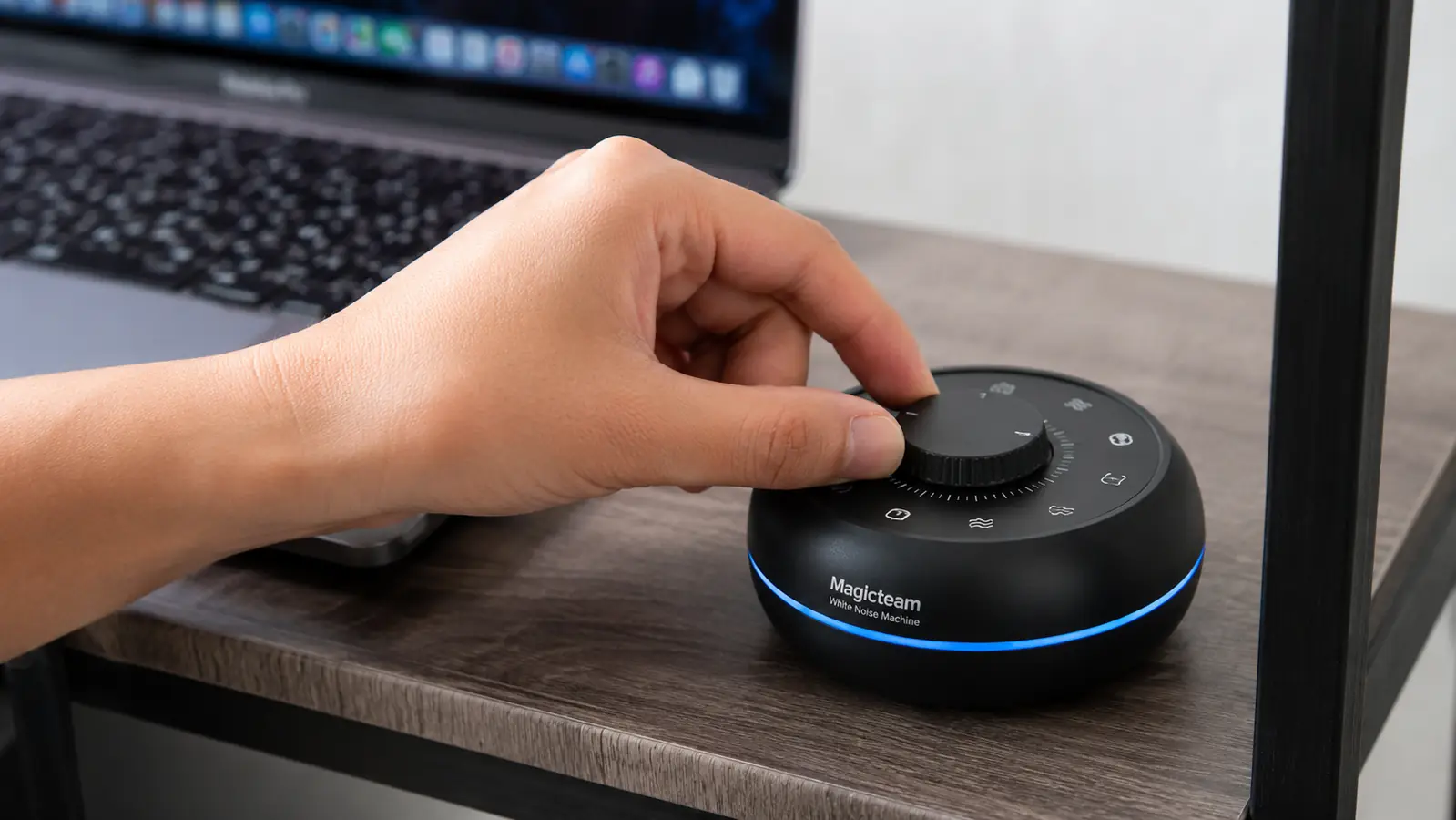
Where the Magicteam White Noise Machine Wins
The floor register was my actual enemy, and no amount of foam on a wall was ever going to change what came up through the vent from the kitchen below. Once I set the Magicteam machine on the shelf near my door and dialed in the ocean wave setting at around level 14, my recorded test calls stopped picking up the blender, the dishwasher, and most of the dog barking entirely. The 20 non-looping sound options matter more than they sound like they should on paper. A generic hum drones in a way your ear starts to notice after twenty minutes, but a natural sound that never repeats its loop stays in the background where it belongs, and I stopped consciously hearing it within the first few calls.
The 32 volume levels also let me match the masking sound to whatever was actually happening downstream, which is a level of control a lot of cheaper machines don't offer. Loud vacuuming day, I'd bump it up two or three notches. Quiet Sunday afternoon call, I'd dial it back so it wasn't doing more work than the room needed. It runs off USB power, so it lives on a shelf with no cord clutter near my desk, and the memory function means it comes back on the exact sound and volume I left it at instead of resetting every time, which sounds minor until you've had to fumble through settings thirty seconds before a call starts.
Portability turned out to be the sleeper feature. I travel for work roughly once a month, and I started tossing the machine in my bag for hotel stays where the walls are thin and the hallway traffic never really stops. It has done more to protect my sleep in a Marriott off the interstate than it has for my actual work calls, honestly, which tells you something about how versatile a $17 device can be once you own one. Try mounting a wall's worth of foam panels in a hotel room and see how that goes.
Five months in, mine still runs without a hiccup. I run it eight or nine hours a day most weekdays, off USB power straight from a wall adapter, and the dial hasn't gotten loose or scratchy the way cheap electronics sometimes do after heavy daily use. That's the kind of thing you only find out by actually living with a product for a while, not by reading the spec sheet on the Amazon listing.
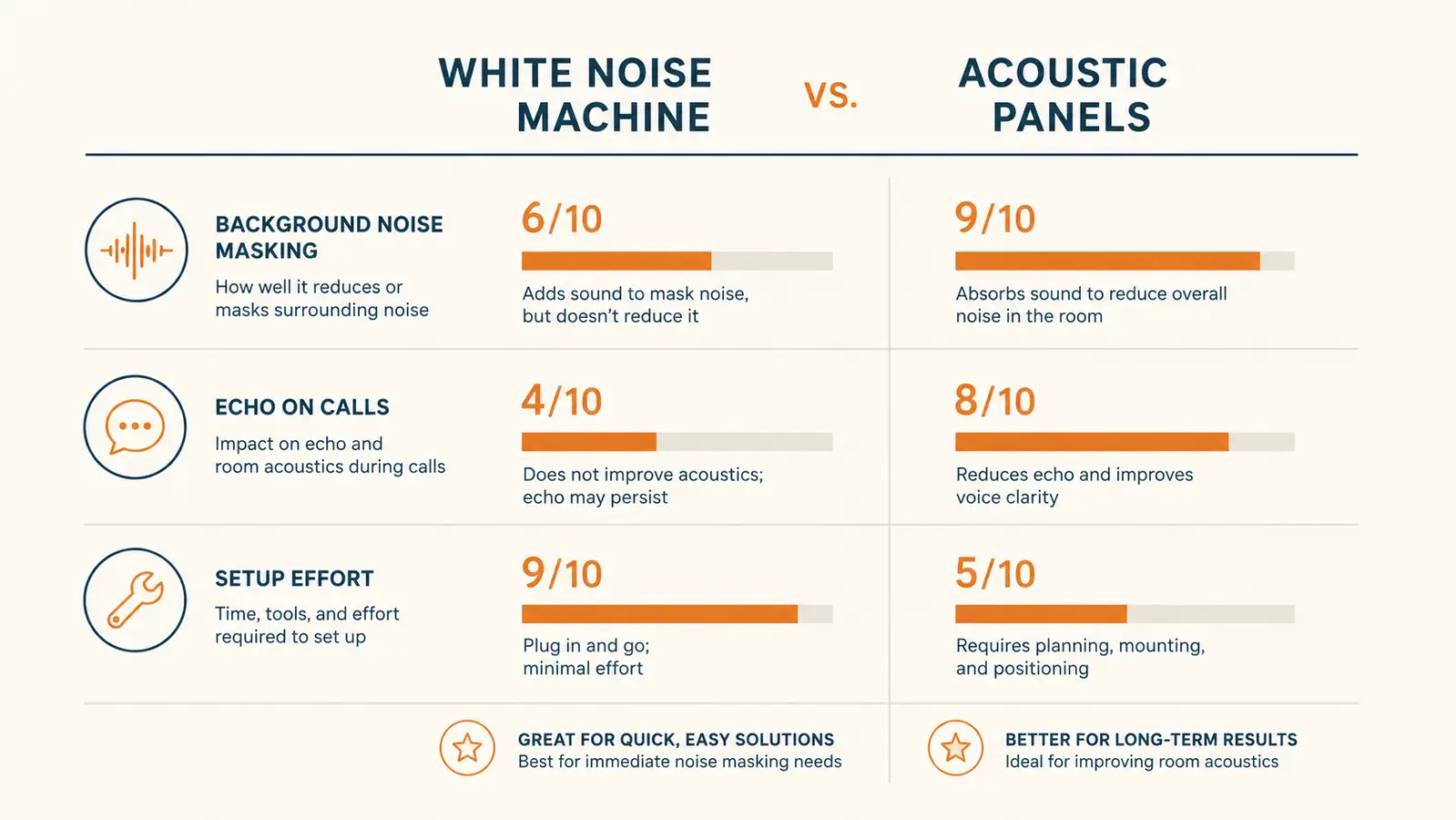
Where Acoustic Panels Win
I'd be lying if I said the white noise machine fixed everything, because it didn't touch my actual voice quality. My attic room has a sloped drywall ceiling and one long bare wall, and a coworker flagged early on that I sounded like I was talking from inside a stairwell. Running the Magicteam machine through that same call did nothing for the echo, and if anything it added a second sound source into an already reflective room, which made my own recordings slightly muddier rather than cleaner. That's not a flaw in the machine, it's just not the tool for that particular job, and it's physics, not marketing.
Acoustic panels solve that specific complaint directly, because they change how sound behaves once it leaves your mouth and hits a wall instead of trying to cover up sounds from somewhere else. Mounting a dozen wedge-cut foam panels on the wall behind my monitor took about 40 minutes with adhesive squares, no drilling, and my next test recording came back noticeably flatter and closer sounding, the difference between an empty room and a room with furniture in it. They also work with zero effort once installed. I've forgotten to switch on the white noise machine before an important call more than once. The panels don't have that failure mode, since there's nothing to remember to turn on.
There's also a durability tradeoff worth knowing about before you mount anything. My office wall gets a couple hours of direct afternoon sun through the window, and cheap foam can yellow or crumble along the edges after a few months of that kind of exposure. Mine have held their gray color fine so far, but I'd check that specifically on whatever brand of panels you consider, since it's not something a listing photo will show you and it matters if your wall gets any real sunlight.
If a dog, a dishwasher, or a noisy street keeps crashing your calls, no wall treatment is going to fix that.
The Magicteam White Noise Machine masks outside noise the moment you flip it on, with 20 natural sounds and 32 volume levels to match whatever your house throws at you. See today's price and stop apologizing for background noise on your next call.
Amazon Check Today's Price on Amazon →
Who Should Buy Which
If people on your calls keep asking you to repeat yourself, or your own recorded voice sounds thin and distant even to you, that's a room problem, and acoustic panels are the fix. Start with the wall closest to your desk and microphone, since that surface is doing the most damage. If instead your voice sounds fine but a barking dog, a busy street, or a housemate's TV keeps showing up in the background, buy the white noise machine first. It won't touch echo, and running it in a genuinely bad-sounding room can add clutter rather than fix anything, so it's worth being honest with yourself about which complaint is actually yours before you spend the money.
My own setup ended up running both, and I don't think that's unusual once people actually diagnose their problem correctly. The panels stay mounted behind my desk permanently, doing their job whether I remember them or not, and the Magicteam machine sits on the shelf near the door, switched on only when the house gets loud during work hours. Total cost for both landed under $32, and it solved two separate complaints that neither product was ever going to fix on its own. If you can only buy one right now, though, go back to the actual feedback you've gotten. Echo complaints mean panels. Background noise complaints mean the machine.
If you're renting, or you move apartments often, that's another factor worth weighing on top of the noise diagnosis. The machine goes with you in a bag, no adhesive marks left behind, no wall to patch when you move out. Panels are a better long-term investment if you own your place or plan to stay put for a while, since you get years of passive echo control out of a single 40-minute install. If you're somewhere temporary and dealing with outside noise more than echo, the machine is the lower-commitment answer either way.
One quick test before you decide anything. Record 30 seconds of yourself talking on your phone, right now, in your actual office chair. Play it back. If your own voice sounds hollow or like you're in an empty stairwell, that's echo, and the panels are your answer. If your voice sounds normal but you can hear a dog, a TV, or traffic bleeding in behind it, that's a masking problem, and the white noise machine is built for exactly that. That one test will settle the decision faster than any spec sheet, this one included.
You can't control what's happening on the other side of your office door, but you can control whether anyone hears it.
The Magicteam White Noise Machine runs on USB or battery power, remembers your last setting, and travels with you if you work from hotels or a second location. Check the current price before your next round of back-to-back calls.
Amazon Check Today's Price on Amazon →